Sophie Tao
ui/UX DESIGN · 2025
Plateful
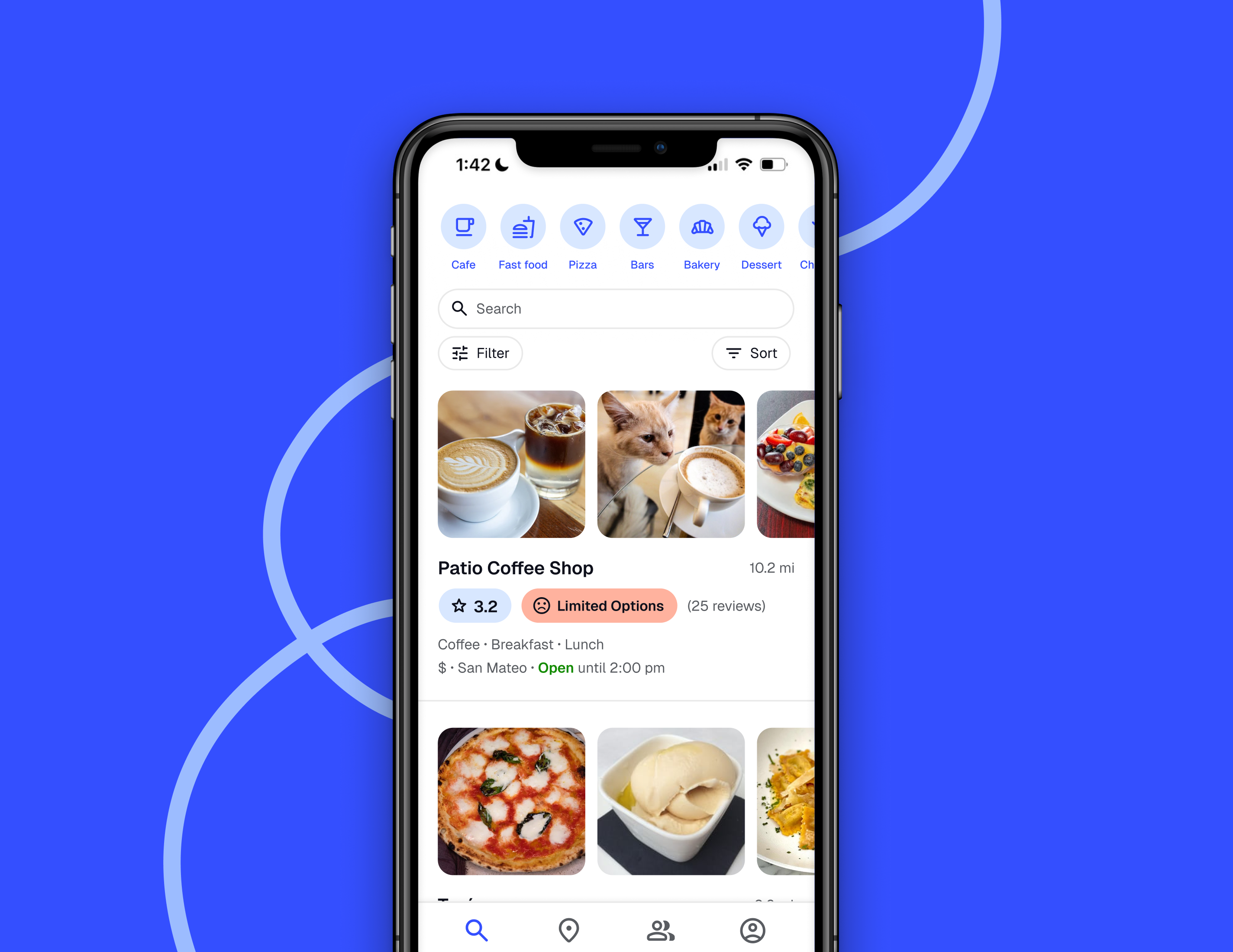
Plateful is a mobile app that helps people with food allergies navigate restaurant choices by finding verified allergy-safe restaurants and dishes tailored for their allergies, reading community reviews, and coordinating with friends.
RATIONALE
For people with food allergies, finding restaurants can be a source of uncertainty and stress.
For people with food allergies, the excitement of eating out can often be overshadowed by the uncertainty of finding something safe to eat. This project aims to make dining out more approachable by helping users discover allergy-conscious restaurants and navigate menu options.
RESEARCH
I used a combination of secondary and primary research to understand how people navigate food allergies and how existing digital tools help people manage their allergies.
FIRST-HAND EXPERIENCE
I spent a week living in the shoes of someone with a wheat allergy to understand their experiences, taking notes on what challenges I faced and what I found helpful.
Key findings
- It was frustrating to find restaurant food that I could eat and actually wanted to eat.
- I spent most of the week eating soy sauce without realizing it contained wheat, so I would have liked a resource to help me understand which ingredients are not allergy-safe.
- I appreciated when restaurant menus and packaged foods included allergen warnings.
- I felt uneasy when requesting an ingredient substitution at a restaurant.
Design implication
- Help users quickly identify restaurants with allergy-accommodating options while considering food preferences.
- Help users identify hidden allergens in food items.
- Clearly communicate allergen information and potential substitutions, and make it easier for users to communicate their dietary needs with restaurant staff.
INTERVIEWS
I interviewed three people living with different food allergies: shellfish, tree nuts, and dairy.
Key findings
- Many participants said the biggest challenge in day-to-day life was finding allergy-safe restaurants to dine at, especially when traveling.
- Many said they would like detailed ingredient lists on restaurant menus as they struggled to identify allergens hidden in ingredients that weren't explicitly listed.
- Participants avoided unfamiliar dishes or restaurants when they couldn't confidently determine whether a food was safe.
- Participants sometimes felt uncomfortable asking restaurant staff about ingredients or explaining their allergies.
Design implication
- Provide detailed allergen breakdowns for menu items.
- Help users discover restaurants and menu items that accommodate their dietary needs and reduce uncertainty.
- Make allergy information easy to access.
- Allow users to personalize their dietary profiles.
COMPETITIVE ANALYSIS
I conducted competitor research to understand what tools that help people manage their allergies are already on the market.





Key findings
- The restaurant-focused apps I found were outdated and unpolished in design, or overly narrow to one specific allergy.
- Food item–scanning apps reported specific ingredients, but restaurant-finder apps did not show specific ingredients for menu items.
Design implication
- Opportunities exist for an app that helps users find allergy-friendly restaurants and lists specific ingredients/allergens.
SYNTHESIS
01
One of the main challenges for people with food allergies is finding new allergy-friendly restaurants.
02
Users with food allergies care about seeing specific ingredients and allergens.
03
Verified menus and ingredient substitutions from restaurants give users peace of mind.
I decided to design an app that would not only help users find safe restaurants, but also find safe dishes on a restaurant’s menu and share their thoughts with the community through reviews.
DESIGN PROCESS
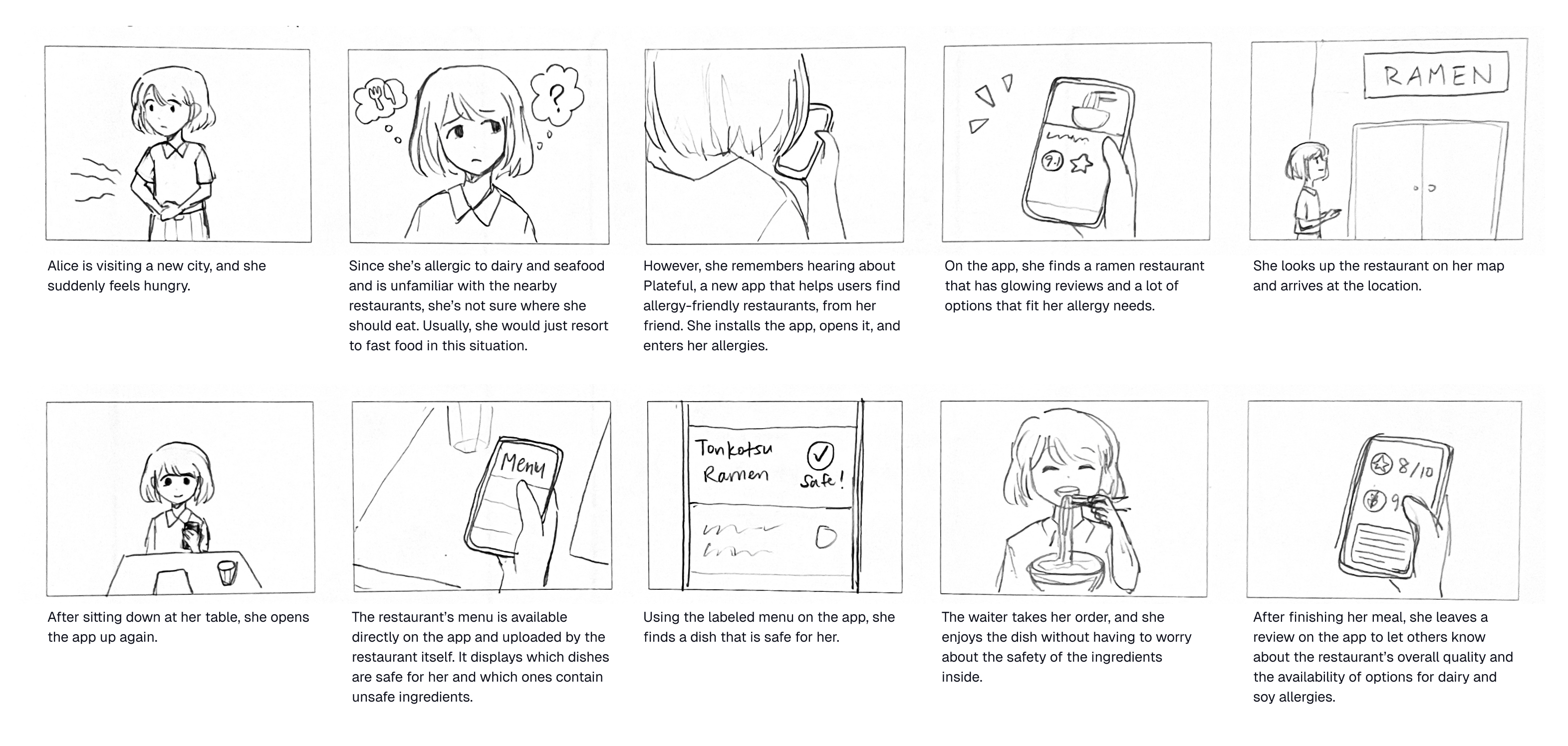
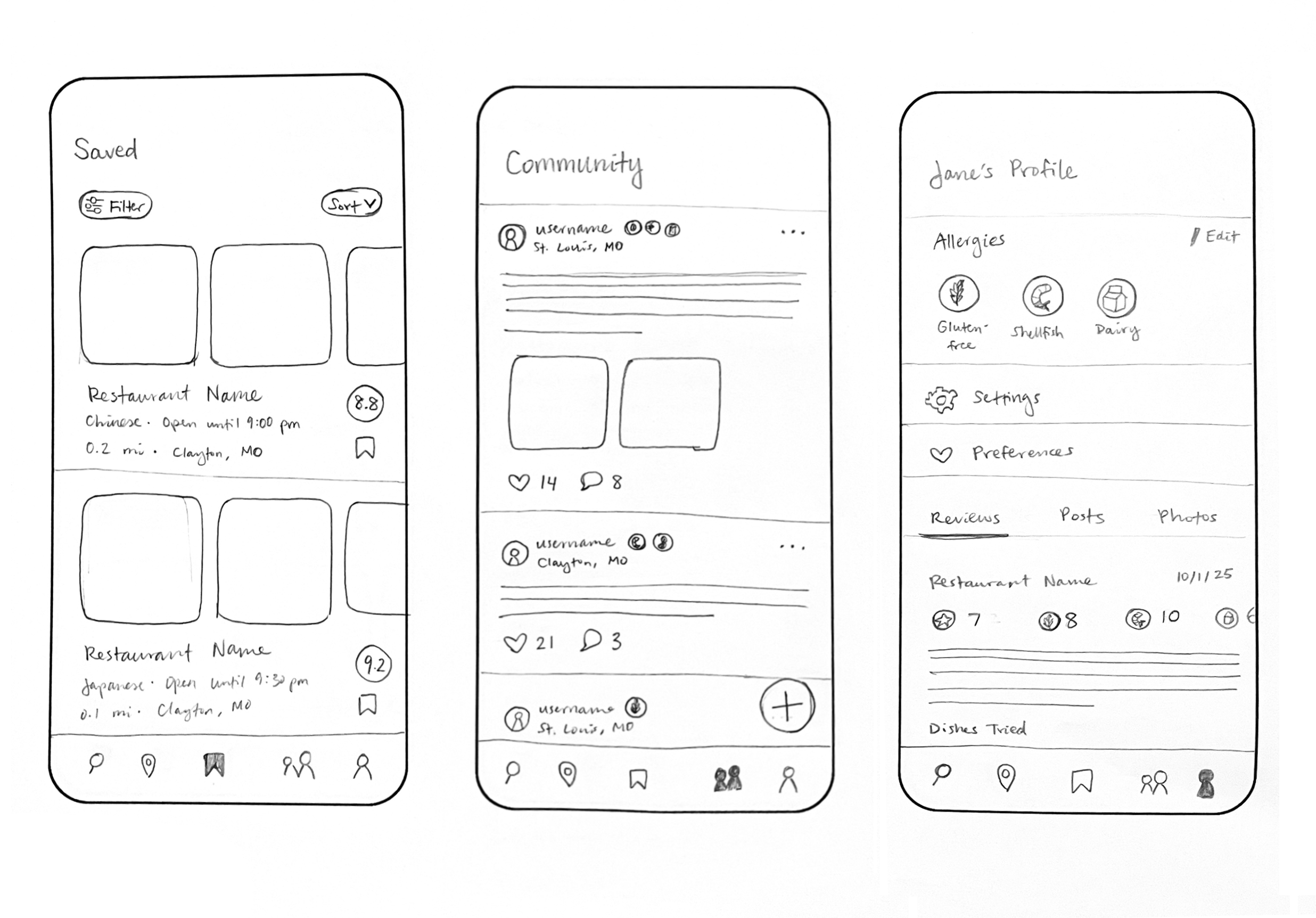
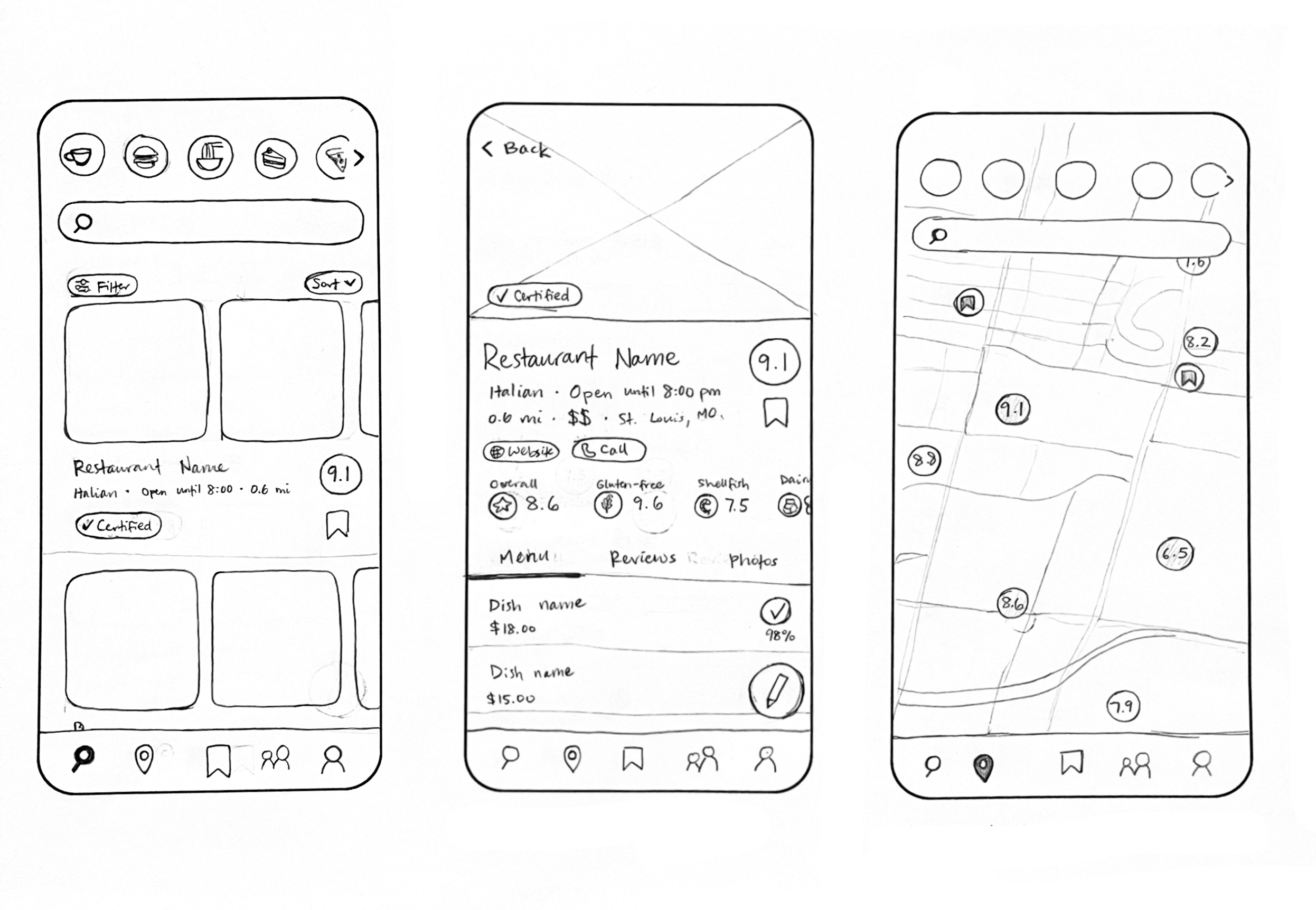
Through ideation, wireframing, and iterative prototyping, I developed a system that would allow users to review restaurants’ allergy-friendliness and find personalized recommendations based on their allergies.
STORYBOARD
WIREFRAMES
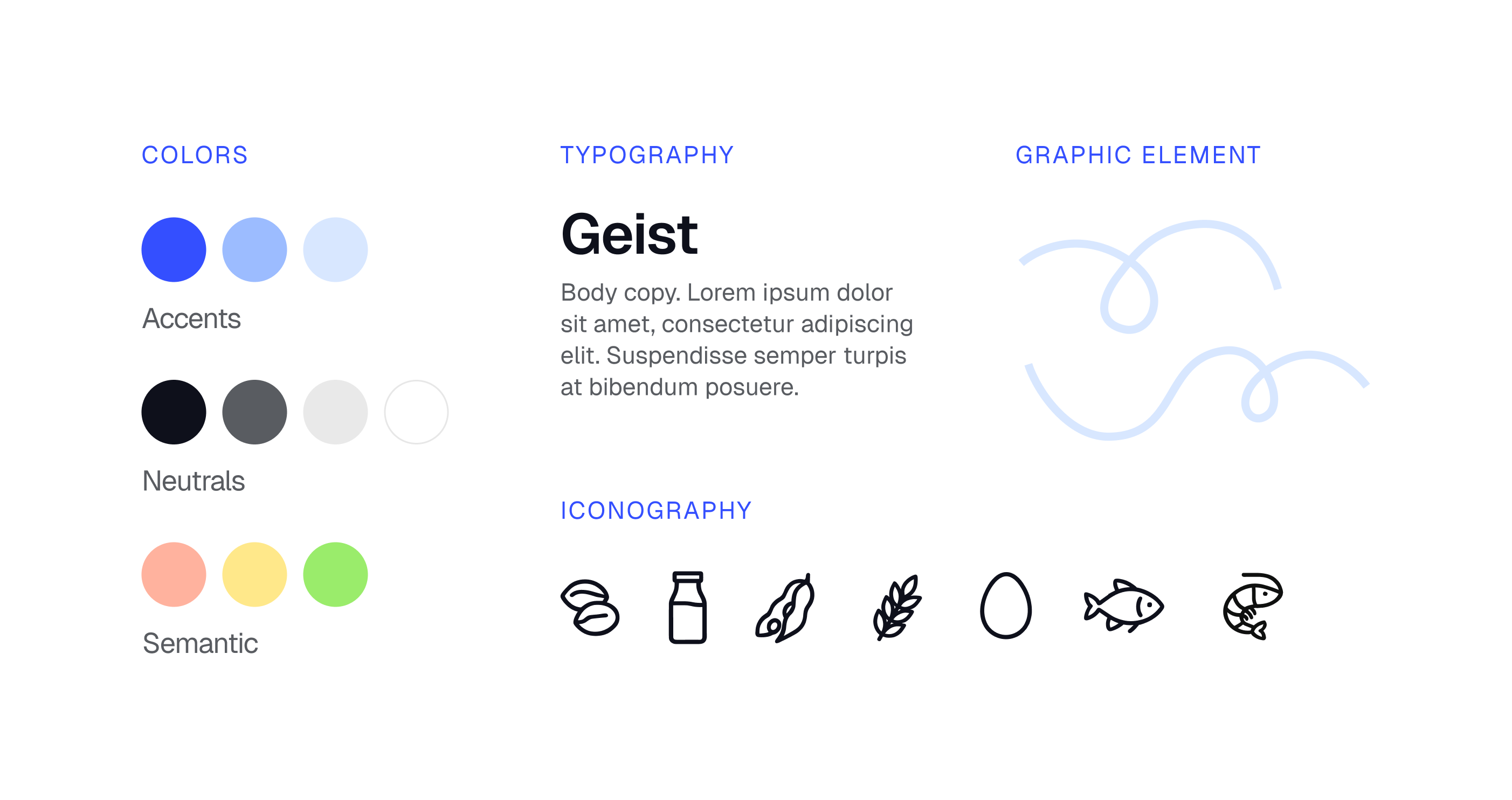
DESIGN SYSTEM
KEY FEATURES & DESIGN DECISIONS
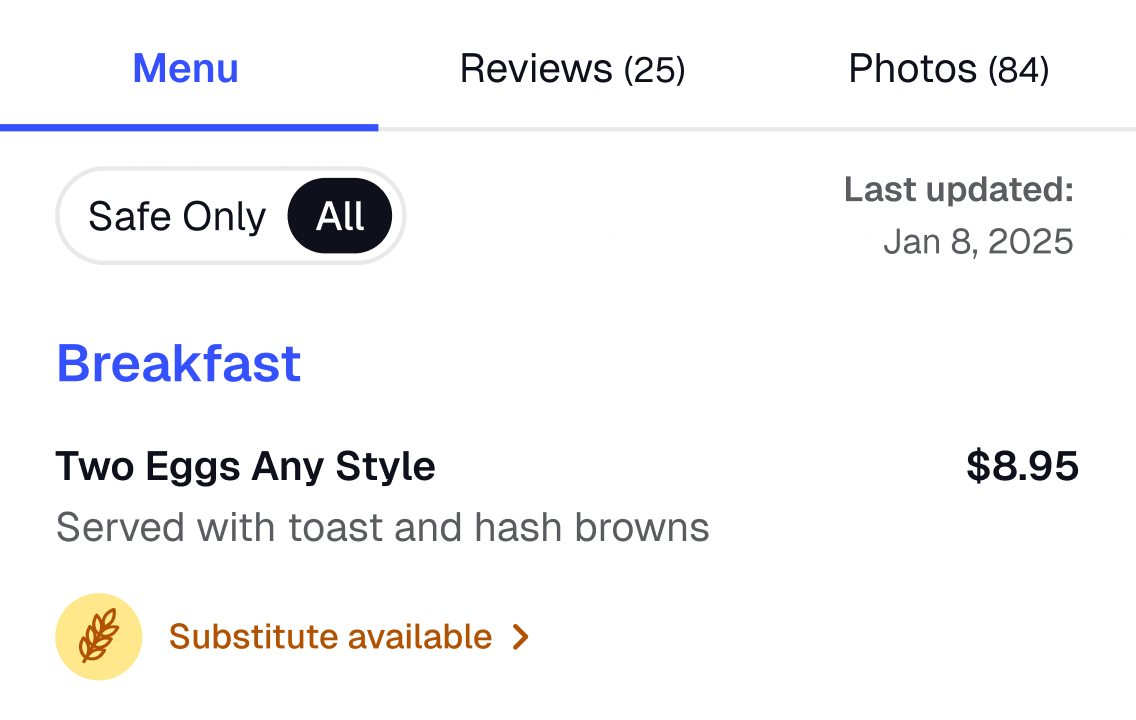
Two-way system
Restaurants can join the app and enter their menu and ingredient list. Users can view the verified menu and see what items are safe or unsafe for them.
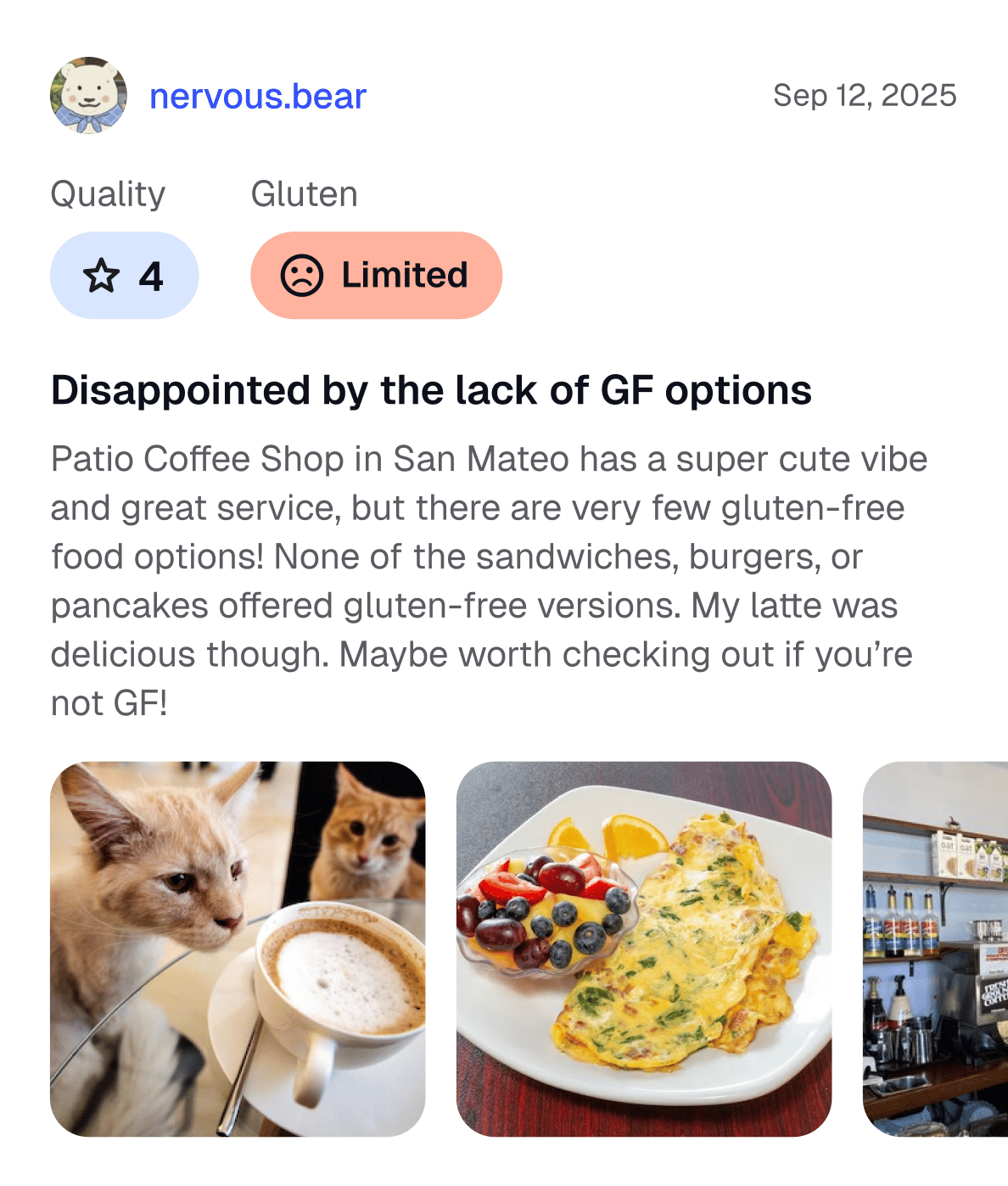
Community reviews
Users can share their experiences with restaurant safety and staff awareness and see reviews from other users who have the same allergies.
Personalized rating
Restaurant ratings are personalized to each user based on reviews from others with the same allergies as well as overall restaurant quality.
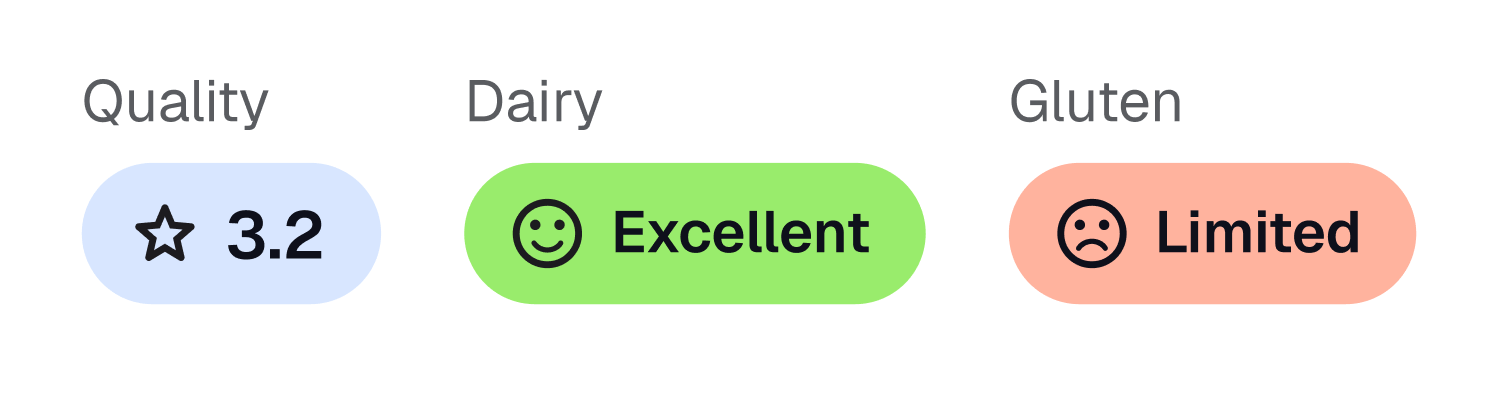
I conducted user testing sessions to identify what users resonated with and what they found confusing or unhelpful. Based on their feedback, I adjusted how the app displayed both restaurant quality and allergy-friendliness scores to make it clearer and more intuitive.
Some users also expressed that they wanted a social feature to coordinate with friends, so I added a feature that allows users to add friends on the app and see their friends’ allergy-friendliness scores for each restaurant, making it easier to dine out as a group.
KEY FEATURES
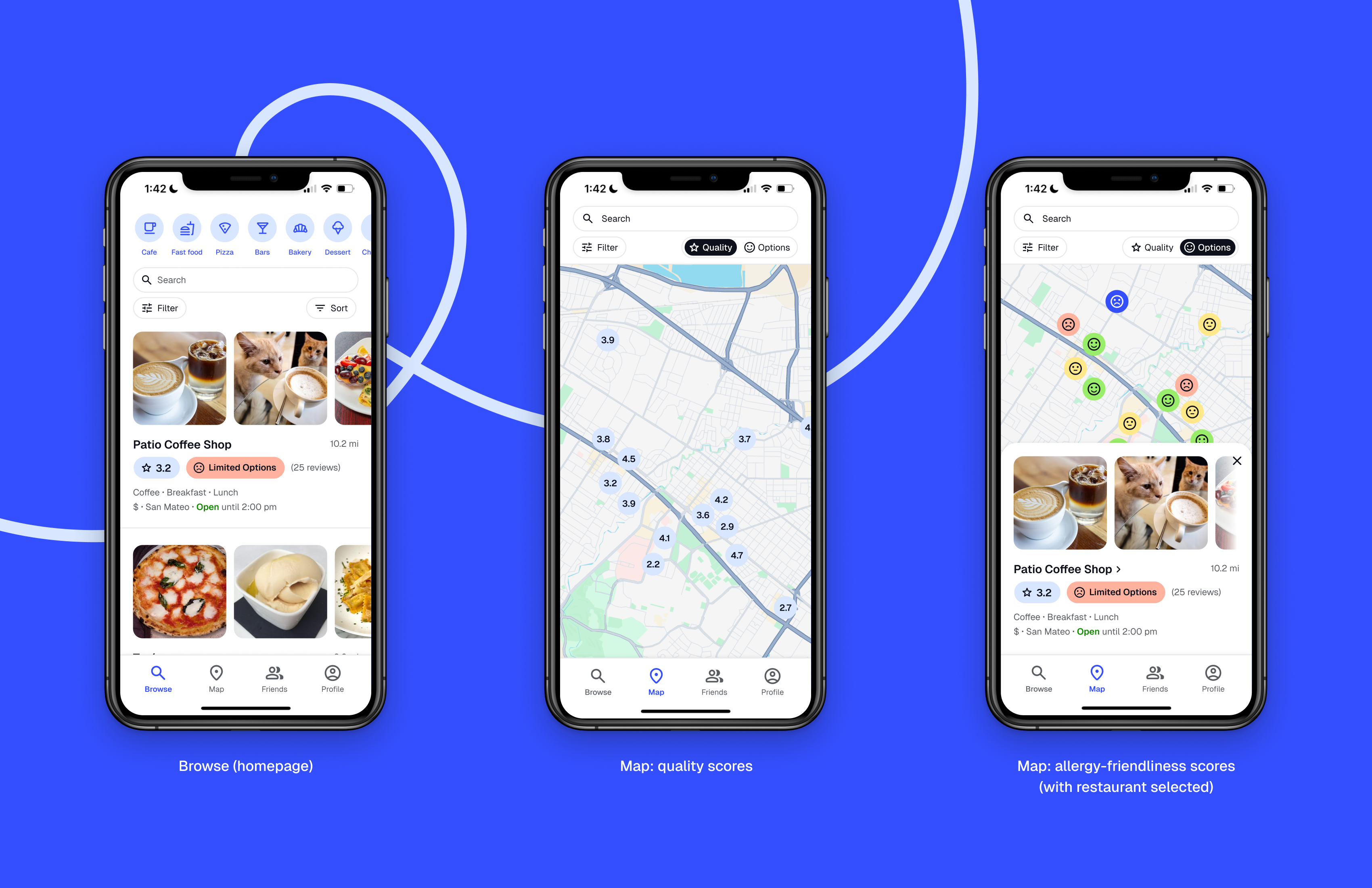
Browse restaurant recommendations in two views—list or map—and see their quality and their personalized allergy-friendliness score.
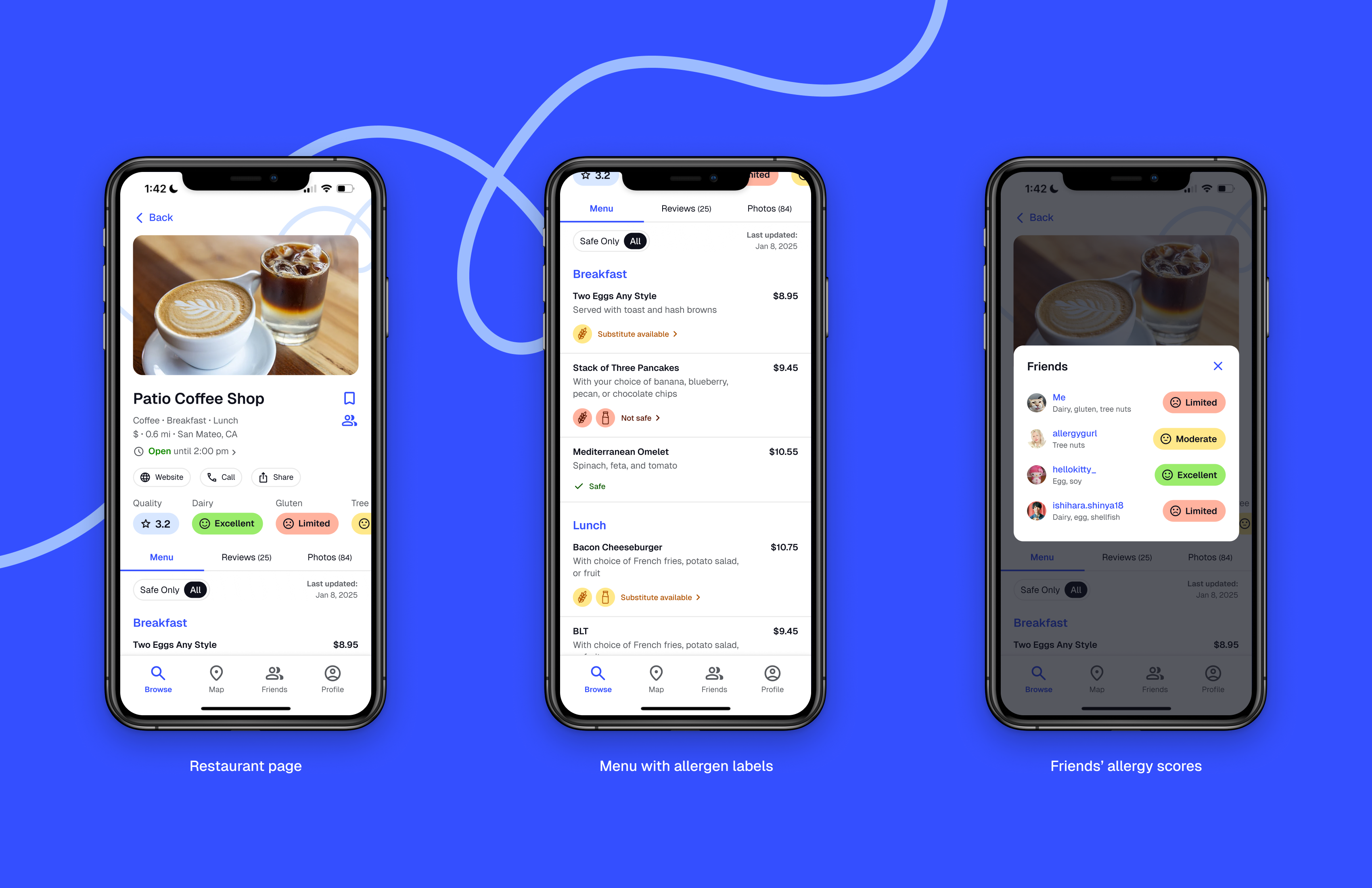
See restaurants’ information, quality score, and allergy-friendliness scores in one comprehensive view. Look through verified menus with items clearly marked as safe or unsafe, including detailed allergen labels and substitutions based on your profile. See how well each restaurant suits your friends’ allergy needs.
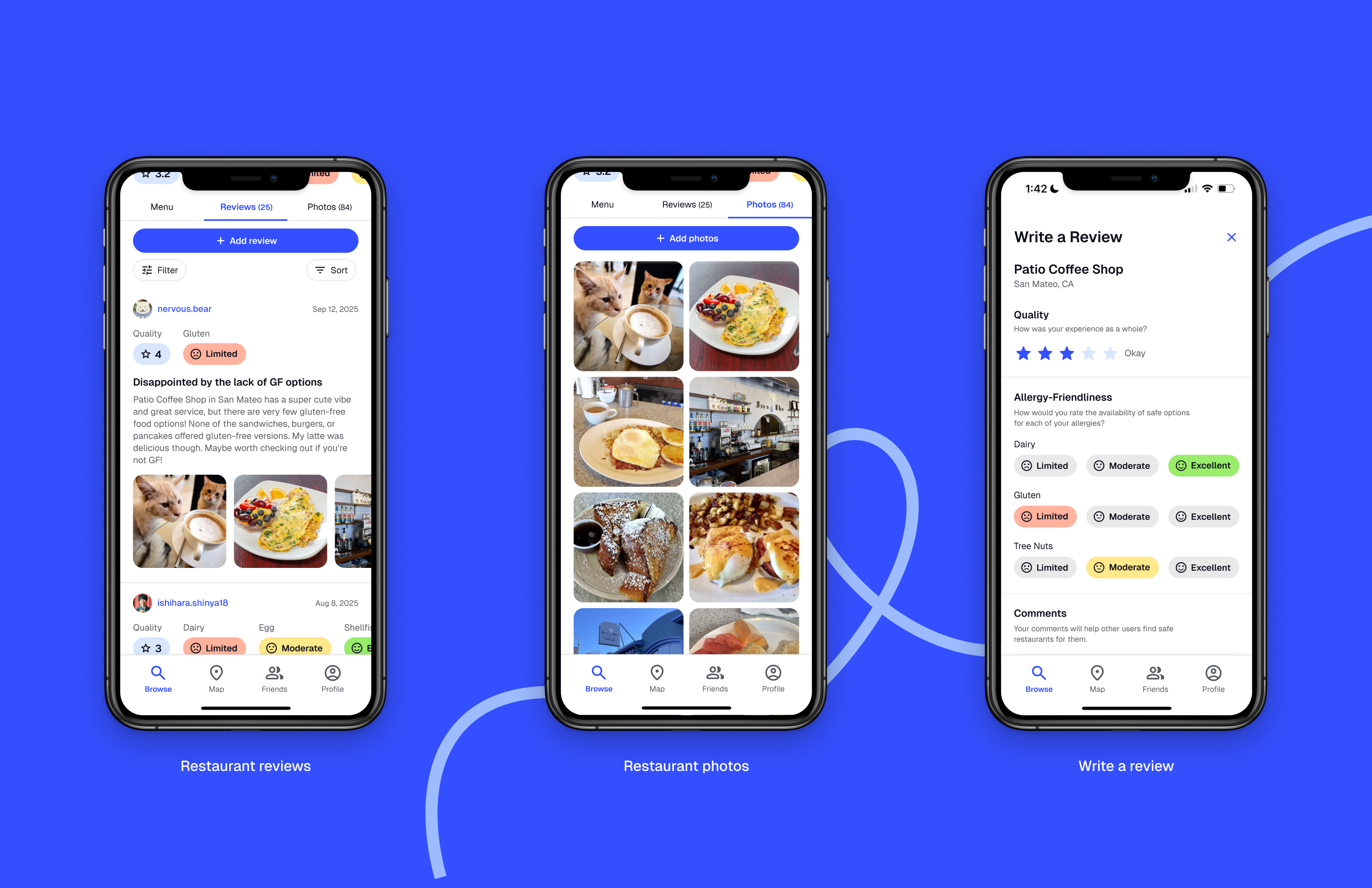
Read reviews and browse photos from other users, and filter for others with the same allergies as you. Write reviews and add photos to share your experience.
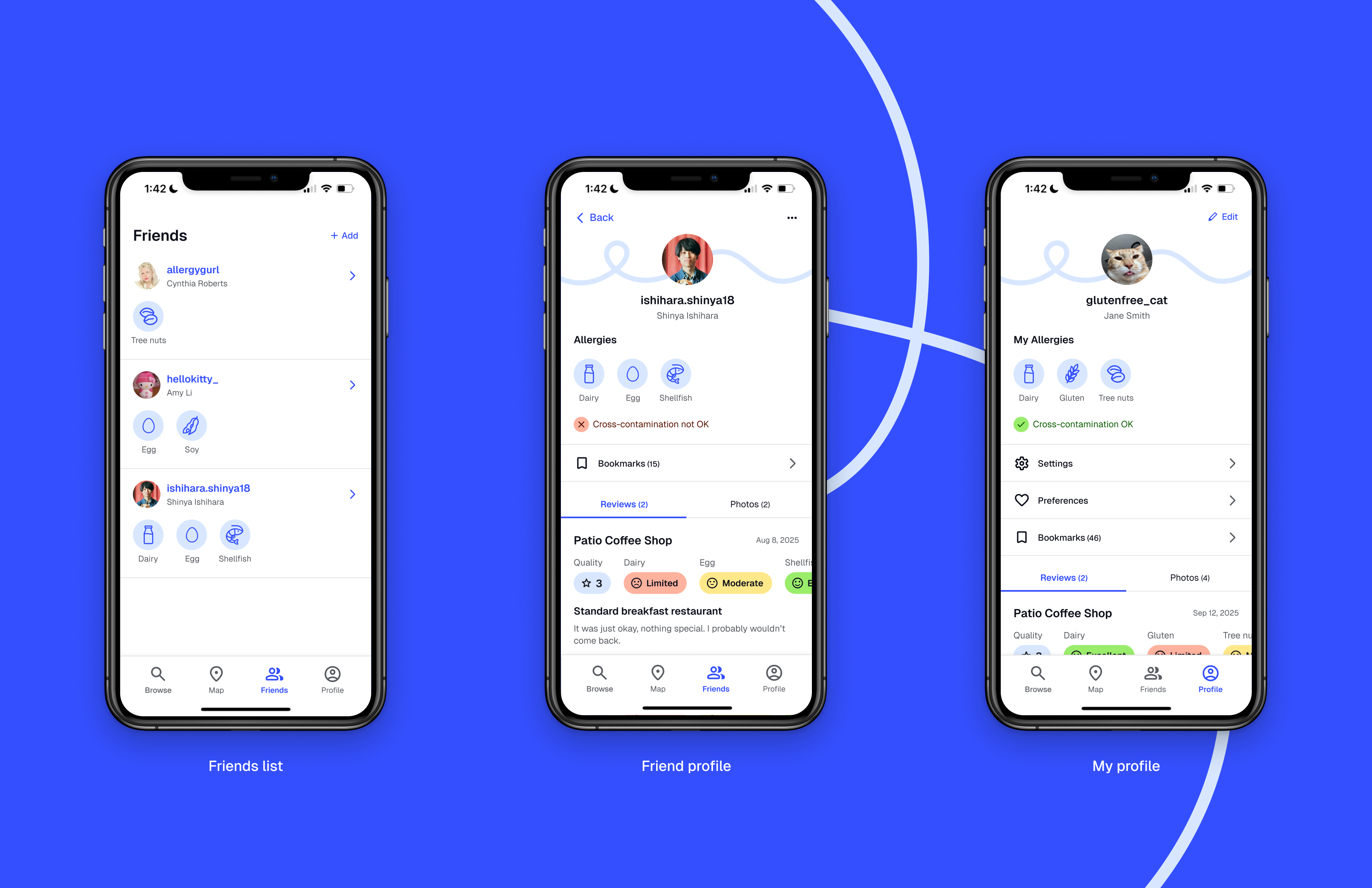
Add friends and see their profiles to understand their allergy needs. Create your own profile with detailed allergy information, including whether cross-contamination is OK or not. Save bookmarks and restaurant preferences to receive tailored recommendations.

REFLECTION & NEXT STEPS
One question I would continue exploring is whether this experience needs to exist as a standalone app or could be integrated into an existing restaurant discovery platform like Yelp, Beli, or Google Maps. Leveraging existing restaurant listings, menus, and reviews could provide a pre-existing set of data while reducing friction for users by making allergy-specific information accessible within tools they already use.
This project was also a valuable experience in designing for a user group whose lived experiences I don't share. Through interviews, I learned to move beyond my own assumptions and better understand the frustrations, uncertainties, and everyday considerations involved in navigating food allergies. It reinforced the importance of user research in grounding design decisions in people's actual needs rather than assumptions.
© Sophie Tao 2026
Sophie Tao
ui/UX DESIGN · 2025
Plateful
Plateful is a mobile app that helps people with food allergies navigate restaurant choices by finding verified allergy-safe restaurants and dishes tailored for their allergies, reading community reviews, and coordinating with friends.
RATIONALE
For people with food allergies, finding restaurants can be a source of uncertainty and stress.
For people with food allergies, the excitement of eating out can often be overshadowed by the uncertainty of finding something safe to eat. This project aims to make dining out more approachable by helping users discover allergy-conscious restaurants and navigate menu options.
RESEARCH
I used a combination of secondary and primary research to understand how people navigate food allergies and how existing digital tools help people manage their allergies.
FIRST-HAND EXPERIENCE
I spent a week living in the shoes of someone with a wheat allergy to understand their experiences, taking notes on what challenges I faced and what I found helpful.
Key findings
- It was frustrating to find restaurant food that I could eat and actually wanted to eat.
- I spent most of the week eating soy sauce without realizing it contained wheat, so I would have liked a resource to help me understand which ingredients are not allergy-safe.
- I appreciated when restaurant menus and packaged foods included allergen warnings.
- I felt uneasy when requesting an ingredient substitution at a restaurant.
Design implication
- Help users quickly identify restaurants with allergy-accommodating options while considering food preferences.
- Help users identify hidden allergens in food items.
- Clearly communicate allergen information and potential substitutions, and make it easier for users to communicate their dietary needs with restaurant staff.
INTERVIEWS
I interviewed three people living with different food allergies: shellfish, tree nuts, and dairy.
Key findings
- Many participants said the biggest challenge in day-to-day life was finding allergy-safe restaurants to dine at, especially when traveling.
- Many said they would like detailed ingredient lists on restaurant menus as they struggled to identify allergens hidden in ingredients that weren't explicitly listed.
- Participants avoided unfamiliar dishes or restaurants when they couldn't confidently determine whether a food was safe.
- Participants sometimes felt uncomfortable asking restaurant staff about ingredients or explaining their allergies.
Design implication
- Provide detailed allergen breakdowns for menu items.
- Help users discover restaurants and menu items that accommodate their dietary needs and reduce uncertainty.
- Make allergy information easy to access.
- Allow users to personalize their dietary profiles.
COMPETITIVE ANALYSIS
I conducted competitor research to understand what tools that help people manage their allergies are already on the market.
Key findings
- The restaurant-focused apps I found were outdated and unpolished in design, or overly narrow to one specific allergy.
- Food item–scanning apps reported specific ingredients, but restaurant-finder apps did not show specific ingredients for menu items.
Design implication
- Opportunities exist for an app that helps users find allergy-friendly restaurants and lists specific ingredients/allergens.
SYNTHESIS
01
One of the main challenges for people with food allergies is finding new allergy-friendly restaurants.
02
Users with food allergies care about seeing specific ingredients and allergens.
03
Verified menus and ingredient substitutions from restaurants give users peace of mind.
I decided to design an app that would not only help users find safe restaurants, but also find safe dishes on a restaurant’s menu and share their thoughts with the community through reviews.
DESIGN PROCESS
Through ideation, wireframing, and iterative prototyping, I developed a system that would allow users to review restaurants’ allergy-friendliness and find personalized recommendations based on their allergies.
STORYBOARD
WIREFRAMES
DESIGN SYSTEM
KEY FEATURES & DESIGN DECISIONS
Two-way system
Restaurants can join the app and enter their menu and ingredient list. Users can view the verified menu and see what items are safe or unsafe for them.
Community reviews
Users can share their experiences with restaurant safety and staff awareness and see reviews from other users who have the same allergies.
Personalized rating
Restaurant ratings are personalized to each user based on reviews from others with the same allergies as well as overall restaurant quality.
I conducted user testing sessions to identify what users resonated with and what they found confusing or unhelpful. Based on their feedback, I adjusted how the app displayed both restaurant quality and allergy-friendliness scores to make it clearer and more intuitive.
Some users also expressed that they wanted a social feature to coordinate with friends, so I added a feature that allows users to add friends on the app and see their friends’ allergy-friendliness scores for each restaurant, making it easier to dine out as a group.
KEY FEATURES
Browse restaurant recommendations in two views—list or map—and see their quality and their personalized allergy-friendliness score.
See restaurants’ information, quality score, and allergy-friendliness scores in one comprehensive view. Look through verified menus with items clearly marked as safe or unsafe, including detailed allergen labels and substitutions based on your profile. See how well each restaurant suits your friends’ allergy needs.
Read reviews and browse photos from other users, and filter for others with the same allergies as you. Write reviews and add photos to share your experience.
Add friends and see their profiles to understand their allergy needs. Create your own profile with detailed allergy information, including whether cross-contamination is OK or not. Save bookmarks and restaurant preferences to receive tailored recommendations.
REFLECTION & NEXT STEPS
One question I would continue exploring is whether this experience needs to exist as a standalone app or could be integrated into an existing restaurant discovery platform like Yelp, Beli, or Google Maps. Leveraging existing restaurant listings, menus, and reviews could provide a pre-existing set of data while reducing friction for users by making allergy-specific information accessible within tools they already use.
This project was also a valuable experience in designing for a user group whose lived experiences I don't share. Through interviews, I learned to move beyond my own assumptions and better understand the frustrations, uncertainties, and everyday considerations involved in navigating food allergies. It reinforced the importance of user research in grounding design decisions in people's actual needs rather than assumptions.
© Sophie Tao 2026
Sophie Tao
ui/UX DESIGN · 2025
Plateful
Plateful is a mobile app that helps people with food allergies navigate restaurant choices by finding verified allergy-safe restaurants and dishes tailored for their allergies, reading community reviews, and coordinating with friends.
RATIONALE
For people with food allergies, finding restaurants can be a source of uncertainty and stress.
For people with food allergies, the excitement of eating out can often be overshadowed by the uncertainty of finding something safe to eat. This project aims to make dining out more approachable by helping users discover allergy-conscious restaurants and navigate menu options.
RESEARCH
I used a combination of secondary and primary research to understand how people navigate food allergies and how existing digital tools help people manage their allergies.
FIRST-HAND EXPERIENCE
I spent a week living in the shoes of someone with a wheat allergy to understand their experiences, taking notes on what challenges I faced and what I found helpful.
Key findings
- It was frustrating to find restaurant food that I could eat and actually wanted to eat.
- I spent most of the week eating soy sauce without realizing it contained wheat, so I would have liked a resource to help me understand which ingredients are not allergy-safe.
- I appreciated when restaurant menus and packaged foods included allergen warnings.
- I felt uneasy when requesting an ingredient substitution at a restaurant.
Design implication
- Help users quickly identify restaurants with allergy-accommodating options while considering food preferences.
- Help users identify hidden allergens in food items.
- Clearly communicate allergen information and potential substitutions, and make it easier for users to communicate their dietary needs with restaurant staff.
INTERVIEWS
I interviewed three people living with different food allergies: shellfish, tree nuts, and dairy.
Key findings
- Many participants said the biggest challenge in day-to-day life was finding allergy-safe restaurants to dine at, especially when traveling.
- Many said they would like detailed ingredient lists on restaurant menus as they struggled to identify allergens hidden in ingredients that weren't explicitly listed.
- Participants avoided unfamiliar dishes or restaurants when they couldn't confidently determine whether a food was safe.
- Participants sometimes felt uncomfortable asking restaurant staff about ingredients or explaining their allergies.
Design implication
- Provide detailed allergen breakdowns for menu items.
- Help users discover restaurants and menu items that accommodate their dietary needs and reduce uncertainty.
- Make allergy information easy to access.
- Allow users to personalize their dietary profiles.
COMPETITIVE ANALYSIS
I conducted competitor research to understand what tools that help people manage their allergies are already on the market.
Key findings
- Many packaged food item–scanning apps reported specific ingredients, but restaurant-finder apps did not show specific ingredients for menu items.
- The restaurant-focused apps I found were outdated and unpolished in design, or overly narrow to one specific allergy.
Design implication
- Opportunities exist for an app that helps users find allergy-friendly restaurants and lists specific ingredients/allergens.
SYNTHESIS
Across my research, three themes emerged:
01
One of the main challenges for people with food allergies is finding new allergy-friendly restaurants.
02
Users with food allergies care about seeing specific ingredients and allergens.
03
Verified menus and ingredient substitutions from restaurants give users peace of mind.
I decided to design an app that would not only help users find safe restaurants, but also find safe dishes on a restaurant’s menu and share their thoughts with the community through reviews.
DESIGN PROCESS
Through ideation, wireframing, and iterative prototyping, I developed a system that would allow users to review restaurants’ allergy-friendliness and find personalized recommendations based on their allergies.
STORYBOARD
WIREFRAMES
DESIGN SYSTEM
KEY FEATURES & DESIGN DECISIONS
Two-way system
Restaurants can join the app and enter their menu and ingredient list. Users can view the verified menu and see what items are safe or unsafe for them.
Community reviews
Users can share their experiences with restaurant safety and staff awareness and see reviews from other users who have the same allergies.
Personalized rating
Restaurant ratings are personalized to each user based on reviews from others with the same allergies as well as overall restaurant quality.
I conducted user testing sessions to identify what users resonated with and what they found confusing or unhelpful. Based on their feedback, I adjusted how the app displayed both restaurant quality and allergy-friendliness scores to make it clearer and more intuitive.
Some users also expressed that they wanted a social feature to coordinate with friends, so I added a feature that allows users to add friends on the app and see their friends’ allergy-friendliness scores for each restaurant, making it easier to dine out as a group.
KEY FEATURES
Browse restaurant recommendations in two views—list or map—and see their quality and their personalized allergy-friendliness score.
See restaurants’ information, quality score, and allergy-friendliness scores in one comprehensive view. Look through verified menus with items clearly marked as safe or unsafe, including detailed allergen labels and substitutions based on your profile. See how well each restaurant suits your friends’ allergy needs.
Read reviews and browse photos from other users, and filter for others with the same allergies as you. Write reviews and add photos to share your experience.
Add friends and see their profiles to understand their allergy needs. Create your own profile with detailed allergy information, including whether cross-contamination is OK or not. Save bookmarks and restaurant preferences to receive tailored recommendations.
REFLECTION & NEXT STEPS
One question I would continue exploring is whether this experience needs to exist as a standalone app or could be integrated into an existing restaurant discovery platform like Yelp, Beli, or Google Maps. Leveraging existing restaurant listings, menus, and reviews could provide a pre-existing set of data while reducing friction for users by making allergy-specific information accessible within tools they already use.
This project was also a valuable experience in designing for a user group whose lived experiences I don't share. Through interviews, I learned to move beyond my own assumptions and better understand the frustrations, uncertainties, and everyday considerations involved in navigating food allergies. It reinforced the importance of user research in grounding design decisions in people's actual needs rather than assumptions.
© Sophie Tao 2026